
Nutrition Science4 min read
Can You Eat Rice at Night and Still Reduce Body Fat?
No single food causes fat gain. Total daily energy balance dictates results, not evening carbohydrates.
Read Evidence
Designed specifically for 22–28 year old desk workers. No 6-meal daily prep, no imported superfoods, and no rigid perfectionism.
"Science determines the principles. Real life determines the solution."

Most body-fat gain between 22 and 28 isn't a lack of willpower. It's the physiological reality of 9 hours sitting coupled with unsustainable fitness advice.
Desk work quietly removes the daily movement your body used to get naturally.
Long hours and shared hostel kitchens make complex meal prep impossible past day three.
Guidance built on imported superfoods ignores what a ₹2,000–₹7,000 monthly food budget actually buys.
Solution by Organics
We don't invent new biology. We take established nutritional evidence and format it to fit high-workload lifestyles.
A moderate gap between calories in and out — large enough to produce results, small enough to sustain for 60 days.
1.6–2.0 g per kg of body weight from eggs, milk, curd, dal, and paneer to preserve lean muscle tissue.
Walking as non-exercise activity thermogenesis (NEAT) rather than high-intensity workout burnout.
No forbidden food lists. Flexible structures prevent ordinary weeks from turning into restarts.

Daily Walking over Weekend Exhaustion
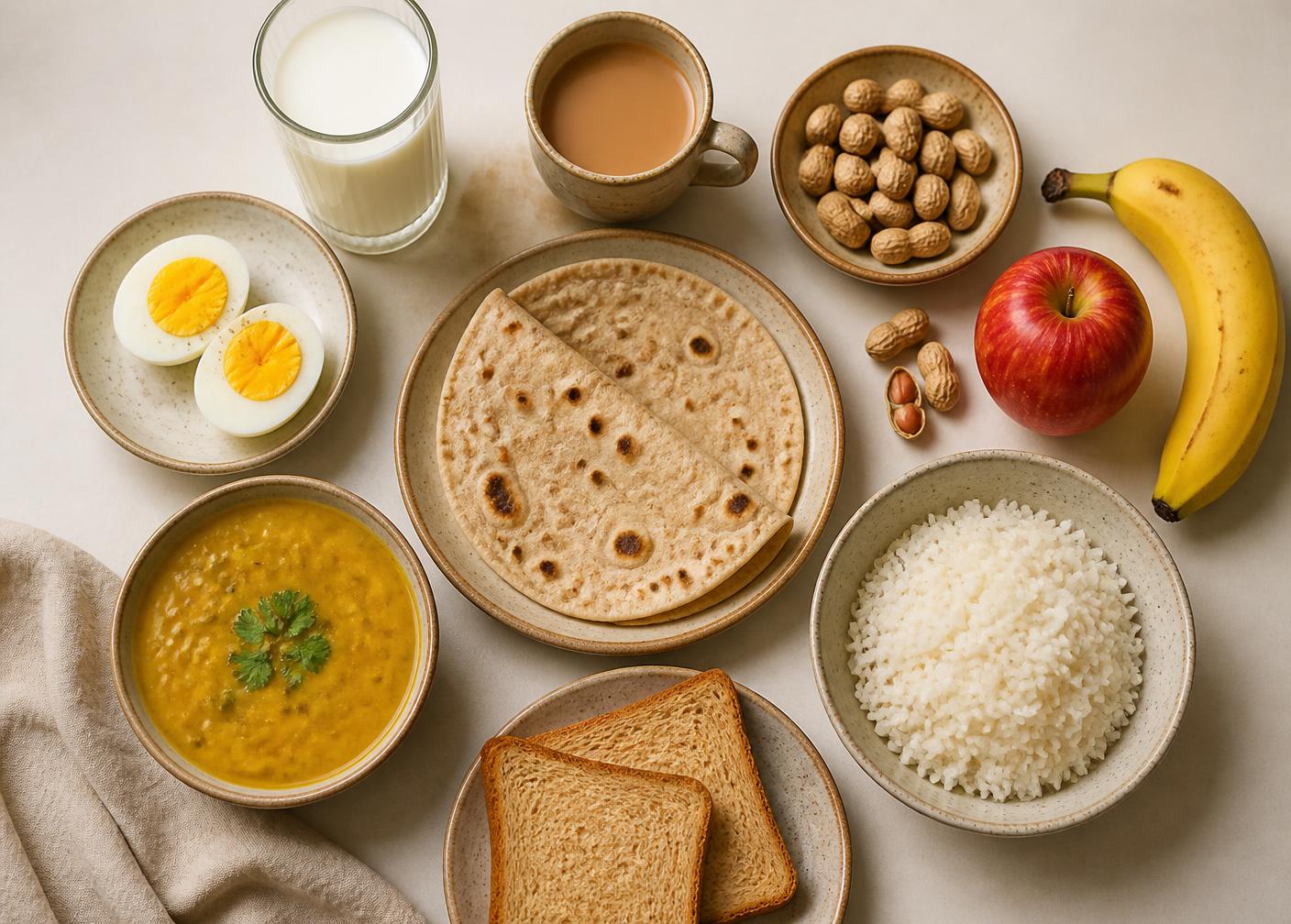
If a fat-loss approach requires food you don't enjoy and cooking equipment you don't own, it's not a program — it's friction.
Eggs, milk, chapati, dal, rice, bread, curd, and peanuts — familiar, affordable staples.
Rice at dinner is completely fine. Total daily energy balance dictates fat loss, not timing.
Maggi or snacks can occasionally fit into your intake without ruining long-term progress.
Structured around practical monthly budgets: ₹2,000, ₹3,000, ₹5,000, or ₹7,000+.
Clear, executable steps with no ambiguous instructions.
The calculator estimates your BMI, BMR, maintenance calories, and target protein range.
Breakfast, lunch, and dinner built from chapati, bhaji, dal, rice, eggs, curd, and peanuts.
Choose a daily step target that fits a standard workday schedule and hit it consistently.
Track 14-day waist and weight averages. Adjust intake only when real stalls occur.
No single food causes fat gain. Total daily energy balance dictates results, not evening carbohydrates.
Meal frequency has negligible impact on metabolism compared to total protein and caloric intake.
Why accumulative step counts protect recovery and appetite far better than drastic gym sessions.
Take five minutes to enter your constraints and receive your customized 3-meal framework and energy targets.
Practical nutrition breakdowns written specifically for busy desk workers. Zero spam.
These outputs are estimates derived from population-level equations and are not medical measurements or diagnoses. Individual results vary. Consult a qualified healthcare professional before making drastic changes, especially if you have an underlying condition or take medication.